Chapter: 12
From the River to the Sea: The Mhadei River Continuum and the Impact of Interventions
Helga do Rosario Gomes
Abstract
This chapter critically examines the ecological, hydrological, and socio-political consequences of human interventions along the Mhadei River continuum—from its forested headwaters in the Western Ghats to its estuarine mouth at the Mandovi in Goa. It focuses on the estuarine zone as a sensitive interface between freshwater and marine systems, where upstream modifications such as damming, water diversion, mining, and pollution intersect to disrupt nutrient cycles, salinity regimes, and food webs. The study presents evidence of drastic changes in water chemistry and biology, including increased salinity intrusion, sediment starvation, and the decline of phytoplankton and benthic biodiversity that underpin Goa’s artisanal fisheries.
Key aspects addressed include the cascading impact of reduced freshwater inflow on estuarine salinity, nutrient availability, and phytoplankton productivity, with direct consequences for fisheries; the disruption of spawning grounds and estuarine habitats due to saline intrusion, altered turbidity, and habitat degradation; the contamination from open-cast mining, microplastics, and untreated sewage, increasing ecological stress and public health risks; shifts in phytoplankton community structure due to nutrient imbalances, potentially leading to harmful algal blooms and food web collapse; and the role of land-use change, mangrove loss, and degraded wetland inputs in weakening estuarine resilience. By framing the river as a living continuum rather than a fragmented resource, the chapter challenges the notion—central to Karnataka’s legal argument—that water reaching the sea is “wasted.” It advocates for integrated, ecologically informed watershed governance to safeguard Goa’s cultural heritage, fisheries-based livelihoods, and coastal integrity.
Introduction
THE Mhadei river (also known as the Mahadayi) is a rain-fed river originating from 30 springs at Bhimgad in the Western Ghats. Its basin spans three states: 4 percent in Maharashtra, 18 percent in Karnataka, and 78 percent in Goa, where it is also known as the Mandovi River (Fig. 12.1).
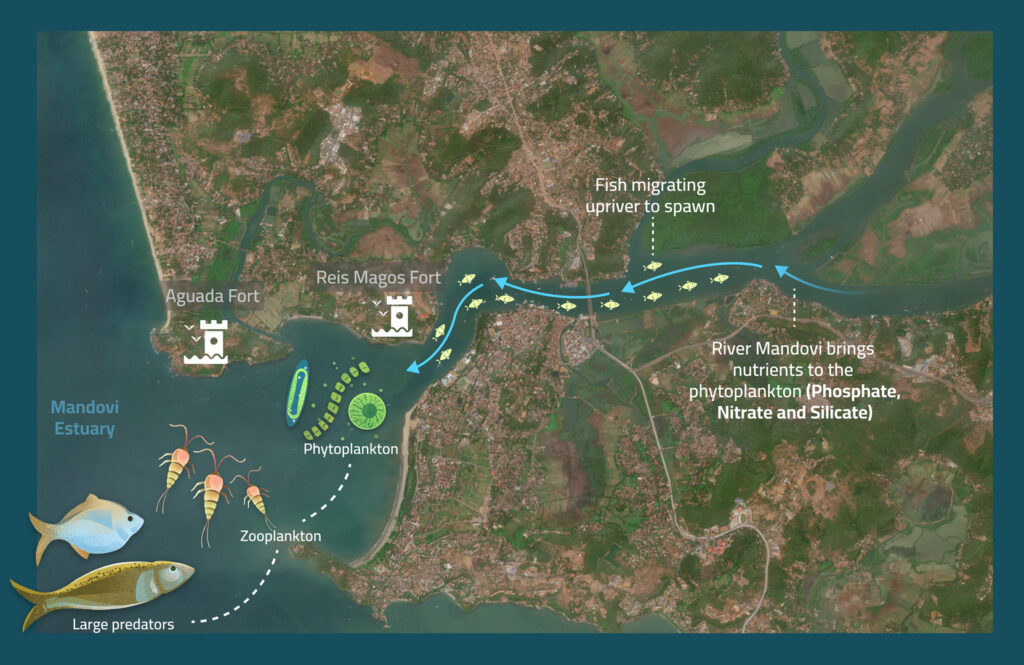
Fig. 12.1: Schematic of the Mandovi River ecosystem with the river supplying nutrients to phytoplankton in the estuary. Phytoplankton photosynthesis supports higher trophic levels such as zooplankton and small and large fish. Schematic is superimposed on a Sentinel-2, Level 2A True Color of the Mandovi Estuary (13 January 2025) courtesy of Copernicus Open Access Hub. Illustration by Divya Ribeiro.
Not only is the river Goa’s primary freshwater source, it also plays a crucial role in regulating the salinity of the khazan farmlands. Khazans are a unique type of coastal wetland found in Goa, used for rice farming, salt production, and aquaculture, while helping protect against coastal erosion. These low-lying areas are created by converting mangrove swamps and tidal flats into productive land through the construction of embankments, canals, and sluice gates to manage water flow (Sonak 2025). The approximately 2,000 sq. km of catchment area of the Mhadei river harbors rich biodiversity (Kerkar, 2025).
The Mhadei River is deeply embedded in the culture, mythology, and religious traditions of Goa, shaping the region’s identity for generations (see Dandekar 2025; Subramanian 2025 in the current volume). Two strategically located forts (Fort Aguada and Fort Reis Magos, see Fig. 12.1), built by the Portuguese along the northern edge of the estuary, serve as symbols of the Mandovi estuary’s strategic importance during the Portuguese colonial era. It is in the upper levels of this estuary that the outgoing Viceroy or the administrative head of the Eastern Portuguese Provinces, handed over the symbolic key to the incoming Viceroy in a majestic procession of boats. Aguada Bay was crucial for ocean-going ships to stock up on water from the Aguada spring, either for their journey or as ballast for a smoother ride. This is how Aguada got its name, meaning “place for water.”
A dispute has emerged between the states of Goa and Karnataka due to the latter’s increasing desire to divert freshwater from the Mhadei, driven by the drinking water needs of its growing urban population, its expanding agriculture, particularly sugarcane cultivation, as well as its increasing industrial needs. To meet this demand, Karnataka has pursued the Kalasa-Banduri project, which aims to divert the Mhadei eastward through dams, canals, and conduits. A similar project is planned on the Banduri nalla, a Mhadei tributary originating in Karnataka’s densely forested Degaon region.
The long-standing and contentious inter-state legal battle has largely tilted against Goa, with claims that the state underutilized its riparian waters, allowing them to “wastefully” flow into the Arabian Sea via the Mandovi estuary (Fig 12.1). However, substantial evidence presented in this issue and elsewhere demonstrates the ecological harm caused by these hydrological modifications. Habitat degradation is leading to biodiversity loss in forests (Pai 2009) and riverine ecosystems, with fish populations particularly at risk due to altered water chemistry (Atkore et al. 2017; Atkore et al. 2020).
Due to the long journey that rivers undertake before reaching the ocean and the significant disruptions caused by dams and water diversions along the river ecosystem, the impact of these upstream interventions on marine ecosystems is often overlooked. Consequently, there is little information or research on the impacts of the Mhadei interventions on the Mandovi estuary. Rivers are not mere conduits for water supply; they form a continuum linking land and sea, transporting water, nutrients, biomass, living organisms, and sediments over vast distances from headwaters to deltas.
This chapter challenges the notion—widely held by water resource developers in India—that a river flowing to the sea is a “waste,” a perspective that has been repeatedly voiced by the Karnataka government in their submission before the Mhadei Water Dispute Tribunal. This chapter seeks to broaden the discussion beyond the irrigation and drinking water arguments in the Tribunal to include aspects of sustainable ecosystems and most importantly the various valuable ecological services that a river provides for the economy, society, and the sustainability of the region in which it flows.
1. Dams, Diversions to the Mhadei and Their Threat to the Mandovi Estuary: Hydrology and Sedimentation
How do the dams and diversions currently being executed threaten the Mandovi estuary? A natural flow regime is essential for sustaining rivers from their headwaters to their deltas. However, large-scale river regulation projects often overlook the fundamental principle that the ecological integrity of a river is largely governed by the dynamic nature of its flow regime (Sofi et al. 2020). Disrupting this natural flow can have profound consequences, not only for ecosystem health but also for downstream hydrology and delta stability (Higgins et al. 2018). One major impact of river diversion and dam construction is the reduction in sediment supply, which causes deltas to sink. This subsidence makes deltas increasingly vulnerable to sea level rise and coastal storm surges. Additionally, altered sediment deposition patterns due to dams can lead to significant socio-economic consequences, including the displacement of communities, disruption of recreational activities, and adverse effects on industries such as fishing. The Damodar Valley Project in Jharkhand and West Bengal, for example, has significantly altered flow duration and flood frequency, demonstrating the far-reaching hydrological impacts of such interventions (Hoque et al. 2022). Despite these well-documented risks, there is currently a lack of long-term monitoring data on basin-scale river flows, discharge rates, and suspended sediment loads for the Mhadei/Mandovi river. This gap in data makes it difficult to develop accurate sediment budget projections for the Mandovi estuary, which supports the city of Panjim (population ˜+70,991) and a highly lucrative boat casino industry. Furthermore, delta subsidence can exacerbate saline intrusion, the consequences of which are discussed later in this chapter.
The prevailing approach to river management in India tends to prioritize water diversion for human use while disregarding the ecological and geomorphological functions of free-flowing rivers. This mindset, which perceives water reaching the sea as a lost resource, has played a key role in shaping judicial and policy decisions, including those based on Karnataka’s water claims. However, such a view ignores the essential role of river discharge in sustaining estuarine and coastal ecosystems. The uninterrupted movement of water and sediment supports biodiversity, stabilizes deltas, and maintains critical economic activities. As the Mandovi estuary faces increasing pres-sures from both anthropogenic interventions and climate change, there is an urgent need to shift away from narrowly utilitarian perspectives and toward an integrated approach that recognizes the river as a dynamic and intercon-nected system.
2. Watershed Connections
Small streams, creeks, and tributaries collectively drain a vast land area into a single river system, forming what is known as a watershed or drainage basin. It can be envisioned as a giant bowl that channels rainfall creeks, streams, rivers, and eventually the estuary and the ocean. Changes to the 2,000 sq. km of Mhadei watershed from damming, water diversions and other anthropogenic activities like deforestation, mining, and construction will severely impact the Mandovi estuary.
2.1 Deforestation
- Kerkar has stated that 43,500 hectares of forest, which is fed by the Mhadei river, risks desertification (Herald 2023). In addition to the myriad severely detrimental aspects to deforestation like decreased evapotranspiration and reduced rainfall, release of stored carbon dioxide etc., deforestation decreases the sponge-like character of trees that hold water and release it slowly over time—a process vital for the health of watersheds. When watersheds lose this natural regulation, it can lead to increased runoff, carrying more sediment and pollutants to the river and finally to the estuary.
2.2 Mining
An extensive study conducted by Gaonkar et al. (2021) in the Mandovi estuary during the pre-monsoon and post-monsoon season showed that open-cast mining activities have been the principal source of iron, manganese, zinc, chromium, copper and lead within the Mandovi estuary. Concentrations of manganese, zinc, and lead were especially high during monsoon season when there was a heavy freshwater runoff. Chromium and lead were especially high in the sediments affecting bottom-dwelling organisms. Parvez Al-Usmani (2018) compared benthic life (bottom dwellers) in the Mandovi estuary to a reference station in Chapora river (which also lies within Goa but is not impacted by mining) during 2010-2011 from three sites along the salinity gradient of both the estuaries. Iron concentration in the Mandovi estuary during the monsoon season was 118.9 ppm (parts per million) while manganese was 2.2 ppm. In contrast, iron and manganese concentrations in the Chapora estuary during the same season were 0.18 and 0.08 ppm respectively. There was a remarkable difference in the benthic ecosystem of the two estuaries: The Mandovi estuary was characterized by an impoverished macrofaunal assemblage that included filter feeders and dominance of scavengers. In contrast, the Chapora estuary had a much higher density, diversity and richness and showed the dominance of filter feeding polychaetes and bivalves. Suspended solid (SS) levels were significantly higher in the Mandovi estuary due to mining activity and its discharge, whereas the Chapora estuary, had lower SS levels (Kessarkar et al., 2015). In the Mandovi, heavier particles settle near mining zones, while finer red clay particles travel further before settling.
The less impacted Chapora estuary which has been used in the above study as a reference site vis-a-vis the Mandovi estuary, remains predominantly sandy year-round, with minor seasonal variations in silt and clay (Babu, 2009). Benthic faunal population was very high, and comprised mainly molluscs and polychaetes, with few crustaceans in lower numbers. Edible filter-feeding bivalves like Meretrix casta and Perna viridis, were observed with minimal epibenthic crustaceans. Soft sediments—a mix of sand, silt, and clay—provide ideal habitats for benthic organisms like worms and bivalves. However, changes in bottom deposits, such as red clay, cobbles, and pebbles observed in the Mandovi estuary, can severely disrupt the settlement and growth of suspension and deposit feeders (Parulekar et al., 1986) devastating the local seafood ecosystem and threatening Goa’s rich seafood culture, which is deeply intertwined with its economy and way of life.
3. Geomorphology
One less obvious effect of damming rivers is how significantly it alters their geomorphology, affecting riverbanks, channels, and streams and reducing the number of habitats and refuges available to fish and wildlife. Dams trap sediment that would naturally replenish downstream riverbanks and channels. This could lead to sediment starvation, increased bank erosion and the breaking of channels (Marren et al. 2014). As there is no natural flow, the small streams and channels do not have enough water-reducing habitat complexity and allow vegetation encroachment. The Mandovi estuary relies on a steady supply of sediment to maintain its structure and stability. The proposed dams will trap suspended sediments and bedload, reducing the amount of material reaching the estuary. This can lead to estuarine and coastal erosion, as wave action and tidal currents remove sediment without sufficient replenishment. Over time, this could shrink sandbanks, mudflats, and mangroves, altering the estuary’s morphology and making coastal areas more vulnerable to sea-level rise. In the upper estuary, bank erosion and bund breaches have occurred due to lack of maintenance, leaving the banks increasingly vulnerable to future erosion.
4. Water Quality and Ecosystems of the Estuary
The above clearly shows that dams and diverting of waters could trigger a cascade of environmental and economic consequences, threatening the long-term viability of the estuary. Three of the most prominent impacts on water quality and consequently the ecosystems of the estuary are salinity, turbidity, and nutrients.
4.1 Salinity
The Mandovi estuary is primarily influenced by the Indian Summer Monsoon leading to its classification as monsoonal (Vijith et al. 2016). Monsoonal estuaries exhibit seasonal variations in conditions depending on the runoff into the estuary. The salinity field of the Mandovi estuary is highly time-dependent, undergoing transitions through all possible states of stratification—riverine, highly-stratified, partially-mixed, and well-mixed—over the course of the year. These changes are driven by the varying runoff, which ranges from high values (∼ 1000 m3/s) during the wet season to nearly negligible values (∼ 1 m3/s) at the end of the dry season (Vijith and Shetye 2012; Vijith et al. 2009; Vijith et al. 2016).
As discussed in Section 2.1, the Mhadei dams will severely impact the hydrology and reduce water flow bringing about saline water intrusion from the Arabian Sea. Many riparian zones in the lower Mandovi have already undergone land-use changes, with paddy fields transitioning into saline marsh-lands, followed by the proliferation of mangroves. This shift is primarily driven by saline water intrusion caused by tidal surges, flooding, and anthropogenic activities such as sand extraction near the banks and embankment deterioration.
A comprehensive study submitted by the National Institute of Oceanography, Goa (National Institute of Oceanography 2021) that assessed sand extraction and its impacts in the Mandovi estuary, surveyed 72 stations for total populations and species diversity of two categories of benthic (bottom-dwelling) organisms. Meiobenthos is the < 1 mm fraction of organisms like nematodes, tardigrades, rotifers, and small polychaetes found within the spaces between sediment particles which serves as food source for larger benthic organisms and is responsible for nutrient cycling and organic matter decomposition. The macrobenthos, larger bottom dwellers like polychaete worms, molluscs (clams, snails), crustaceans (crabs, amphipods), echinoderms (sea stars, sea cucumbers), which burrow in or rest on sediments, attach to hard surfaces, or are free-moving on the seabed. They influence sediment structure and biogeochemical processes and play key roles in food webs as predators, scavengers, filter feeders, or detritivores. They also act as bio-indicators for environmental changes and habitat conditions. Salinity plays a critical role in shaping meiofaunal and macrobenthic communities and influences species composition, population density, and biodiversity. The dynamic salinity gradients that the Mandovi estuary experiences have created diverse habitats for benthic organisms.
Saltwater intrusion and an altered salinity regime will lead to major shifts in benthic communities and an altered food chain. First, marine-dominated species will replace freshwater species which will disappear while euryhaline species that are adapted to variable salinity may proliferate. Second, saltwater intrusion increases sulfate concentrations, promoting sulfate-reducing bacteria that produce toxic hydrogen sulfide (HS), leading to mass mortalities of benthic animals susceptible to HS.
Climate change is making India’s monsoonal rainfall more erratic, with extreme downpours concentrated in short bursts, followed by prolonged dry periods so further reducing river flow to the Mandovi estuary and affecting the delicate salinity balance.
4.2 Sediments
As discussed in Section 2.1, dams trap sediments upstream, leading to sediment-starved waters reaching the estuary. In addition to the collapse of deltas, erosion and rise in sea level, many benthic organisms rely on fine sediments (e.g., mudflats) for burrowing and feeding. Less sediment input can lead to coarser, more compacted substrates, making it difficult for deposit feeders like polychaetes and bivalves to thrive. Sessile organisms (e.g., sponges, barnacles) may struggle to attach if sediment composition shifts to sandier or rockier substrates. Filter-feeding bivalves and scavenging crustaceans may increase if substrate conditions favor them.
4.3 Turbidity
Damming significantly alters turbidity levels in an estuary by trapping sediments upstream resulting in clearer water, allowing more sunlight penetration. There could be a decline in filter feeders (e.g., mussels, oysters) that rely on suspended sediments for food and mangroves could increase their habitat from enhanced light and salinity. Enhanced light penetration would favor some phytoplankton over others with the possibility of the rise of noxious algal blooms. It will also modulate rates of photosynthesis by algal primary producers (phytoplankton) and favor more light-tolerating species. A decreased biodiversity of primary producers and altered rates of photosynthesis will reshape the Mandovi estuary’s food chain.
4.4 Nutrients
Rivers transport about 90% of all dissolved and particulate matter that the estuary receives. Dam construction will affect the biogeochemical cycles of nutrients (carbon, nitrogen, phosphorus, silicon, etc.) in water. The Redfield Ratio (106C:16N:1P) represents the ideal proportion of carbon (C), nitrogen (N), and phosphorus (P) for balanced phytoplankton growth in marine ecosystems.
Any deviation (e.g., excess N or P, reduced silicon—Si) can shift phytoplankton composition, favouring harmful blooms or limiting productivity. In Gomes et al. (2018) we compared two river-ocean systems—the Amazon River Plume and the Changjiang (Yangtze) estuary in the East China Sea—to show how distinctly different N:P ratios of their source waters shape phyto-plankton communities along the river-ocean continuum. The Amazon River which is much less influenced by humans especially N laden sewage, has naturally low N and replete phosphorus P and silica. This nutrient balance supports diatomdiazotroph associations (DDAs), where nitrogen-fixing symbionts compensate for N limitations, allowing high primary production by silica-requiring diatoms that drive primary production globally especially nutrient rich coastal waters. The situation is the reverse in the Changjiang estuary, which is enriched with anthropogenic nitrogen from the highly populated and industrialized coastal cities but P-limited. This favors the dominance of small phytoplankton and cyanobacteria over diatoms, fundamentally altering the trophic structure and productivity of the coastal ecosystem. Diatoms, the larger silica-rich phytoplankton, proliferate in nutrient-rich waters and are directly consumed by zooplankton, which are then eaten by small fish. Diatoms are rich in lipids and essential fatty acids, crucial for the development of zooplankton and fish larvae. In contrast, small phytoplankton generally have less nutritional content, which can reduce the growth and reproduction of consumers most of which are micro-zooplankton which in turn are consumed by large zooplankton. This adds an extra step to the trophic food chain, so less energy reaches higher trophic levels like fish as more steps means greater energy loss. This scenario could unfold in the Mandovi estuary as dams restrict natural freshwater flow, reduce phosphorus and silica inputs while anthropogenic nitrogen from sewage and runoff continues to rise. A 187-day sampling regime conducted by us to monitor phytoplankton species diversity in the Mandovi estuary showed the dominance of diatoms especially in the monsoon season (Parab et al. 2013). This could alter as Si, the nutrient required for diatoms to grow does not have downstream sources and will not be resupplied to rivers after dam interception. This shift could drive nutrient imbalance, favoring non-diatom phytoplankton, potentially leading to harmful algal blooms (HABs) and disruptions in coastal productivity.
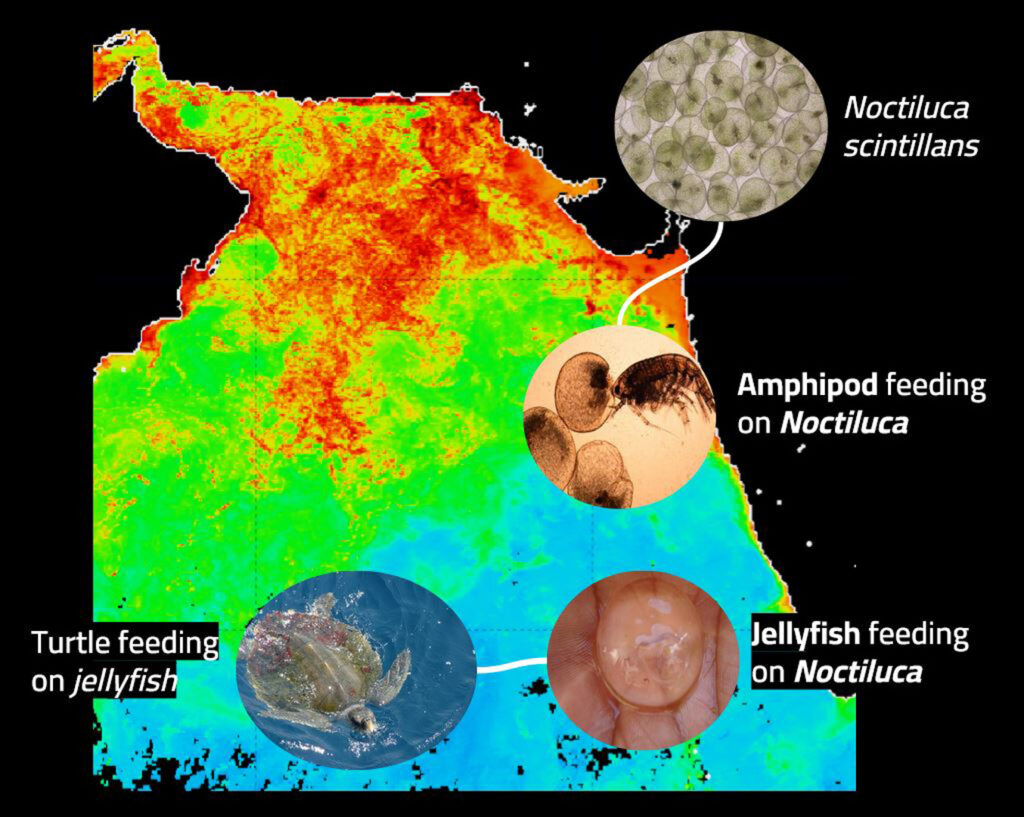
Fig. 12.2: Winter bloom in the Arabian Sea dominated by the mixoplankton, Noctiluca scintillans. Schematic represents the short food chain with jellyfish and turtles as secondary and tertiary producers. This scenario would drastically reduce fish populations. Ocean color image was obtained from NASA Ocean Biology Distributed Active Archive Center (OB.DAAC). Illustration by Divya Ribeiro.
We have already seen a species shift in phytoplankton in the Arabian Sea where non-toxic but noxious blooms of the dinoflagellate Noctiluca scintillans(Fig. 12.2) are now proliferating in the winter waters of the Arabian Sea (Goes and Gomes, 2016; Goes et al., 2020; Gomes et al., 2020; Gomes et al., 2008; Gomes et al., 2014) and replacing the large diatom populations that predominated in the past. Rapid decline in Himalayan-Tibetan snow cover is weakening winter convective mixing and accelerating water accelerating stratification, reducing N from deeper depth. This shift has favored Noctiluca, a mixotroph/mixoplankton (organism that can obtain energy through both photosynthesis and consuming other organisms) that has replaced diatoms as the dominant winter bloom-forming phytoplankton. Noctiluca blooms, though not toxic, pose a growing threat to fisheries and coastal livelihoods by short-circuiting the classic food chain of phytoplankton (primary producers), consumed by zooplankton (primary consumers), eaten by small fish (secondary consumers), followed by larger fish or other predators (tertiary or quaternary consumers) (Figure 12.1).
Noctiluca harbors thousands of photosynthesizing endosymbionts in its large, bulbous cell (Figure 12.2) that provide it with food, but when nutrients for photosynthesis are scarce, it feeds on any available small particles (phytoplankton, flagellates, detritus, nauplii, copepod and fish eggs), making it a strong competitor to primary consumers. As it accumulates a large amount of ammonium in its cell, it is unpalatable to most consumers and its only grazers are jellyfish and salps (Figure 12.2). Salps are generally not a preferred food source for fish and are mostly eaten by turtles. As Noctiluca expands from the open waters of the Arabian Sea into coastal waters, the Mandovi estuary is highly vulnerable to episodic Noctiluca blooms, especially as saline water ingresses into the estuary. We are already seeing large populations of jellyfish off the coast of Goa in recent years.
1.1 Implications of loss/change in phytoplankton biodiversity from changes in nutrient ratios
Changes in phytoplankton biodiversity can have significant ripple effects on the entire aquatic food chain. Phytoplankton form the base of the food web in aquatic ecosystems, serving as the primary producers of energy through photosynthesis. If the composition, abundance, or health of phytoplankton changes, it can disrupt the entire food chain. Reduced phytoplankton populations lead to reduced primary production which can lead to a decrease in the energy available for the next trophic levels (zooplankton, small fish, etc.).
Many aquatic organisms, from zooplankton to fish, have evolved to feed on specific types of phytoplankton. If a shift in phytoplankton biodiversity occurs—such as the dominance of harmful or less nutritious species—organisms that rely on specific phytoplankton types might struggle to find adequate food leading to declines in population numbers. This imbalance can affect higher trophic levels, from fish to top predators like birds and mammals.
2. Impact on Fisheries
One of the earliest clarion calls for sustainable fishing practices and the need for greater attention to environmental conservation to preserve Goa’s coastal ecosystems and the livelihoods of its fishing communities was that of Alvares (2002) in his well-known Fish Curry and Rice. The report contends that over-fishing in near-shore waters, marine pollution, excessive sand extraction, shoreline development, and the destruction of the khazans are threatening Goa’s “fish-curry-and-rice” ethos, which has evolved over centuries in harmony with the environment (Sonak et al. 2016). We are now faced with the emerging threat of the Mhadei dam and water diversions, which will diminish water resources, further exacerbating the challenges faced by the region’s fragile estuarine ecosystems.
The bulk of Goa’s artisanal fish and seafood comes from the brackish water where the biota is subjected to the impact of tides. A network of artificial fish catchment areas is connected to rivulets via streams, with sluice gates installed at the mouths of the catchment areas. This economic activity sustains rural Goa’s population. Further up towards the mouth, fish are harvested using mini traps and nets, capitalizing on the spring tides. This is where the majority of the tastiest fish are caught. The brackish water fish here are prized for their superior flavor, renowned freshness, and diverse variety.
In their highly comprehensive study on the fish composition and assemblage structure of four west coast estuaries that included the Mandovi estuary, Sreekanth et al. (2020) found that the Mandovi estuary had an estimated 154 taxa of fish and a rich biodiversity. A guild of marine juvenile migrants, or species that require sheltered estuarine habitats as juveniles, comprised 105 species while the guild of marine seasonal migrants or marine species that regularly enter estuaries in substantial numbers comprised 53 species. There were 6 diadromous species that spend all of their trophic life in fresh-water/sea and which subsequently migrate out to sea/freshwater to spawn. Some of the high abundance species included mullet, sardines and silverbelllies.
Goa along with several other states along the west coast of India institutes fishing bans typically from 1 June to 31 July during the southwest monsoon. During the monsoon season, many fish species, especially those in coastal and brackish waters, enter their breeding cycles. The fishing ban helps ensure that these fish are allowed to breed and reproduce without disturbance, ensuring that fish populations can replenish. By temporarily halting fishing activities, the ban prevents overfishing and helps maintain healthy fish stocks for the long term. The ban also helps ensure that juvenile fish are allowed to grow to maturity. During this time fishing vessels fitted with mechanical propulsion systems, trawl nets, and purse seine nets are banned.
Damming the Mhadei and diverting its waters could significantly affect these diverse fish populations. The consequent salinity fluctuations could disrupt the delicate balance required for marine juvenile migrants and marine seasonal migrants to thrive.
As described above in sections 4.2 and 4.4, changes in nutrient availability and sediment transport affect primary productivity, thereby impacting food availability especially for herbivorous and planktivorous species. Additionally, diadromous species that rely on unimpeded freshwater-sea connectivity and stable salinity gradients for spawning may face barriers to migration, potentially reducing their populations in the estuary.
3. Inland Water Bodies
Goa has about 1,463 water bodies of which 360 have dried up, silted, or been destroyed beyond repair, according to the Union Jal Shakti ministry’s national water body census (Malkarnekar 2025). The rest are being used for irrigation, water conservation, percolation dams to recharge the groundwater table, and for eco-tourism as they provide important habitats for both migratory and resident birds. The damming and diversion of the Mhadei River could have a cascading effect on the inland waterways of Goa. Siltation and intrusion of saltwater from a reduced water flow could destroy habitat quality for birds and cause loss of biodiversity and potential disruptions to migratory patterns. There could also be reduced water supply to humans, diminished water quality and water table recharge.
4. Additional Environmental Concerns: Sewage and Plastic Pollution in the Estuary
4.1 Sewage
Discharge of untreated domestic sewage into storm water drains, as well as directly into the Mandovi river, was observed during physical surveys conducted in 2014 and 2019 by the Goa State Pollution Control Board. Their report declared the River Mandovi to be the most polluted river in the state due to high levels of coliform bacteria present in the river water mainly due to release of raw sewage and open defecation. The St. Inez Creek which flows through highly urbanized Panjim, dumps urban debris, raw sewage, household-garbage including plastic and even tyre discards into the estuary. Cargo ships, tourist boats and fishing trawlers operating in the River Mandovi are also involved in discharging effluents (Khan, 2017). However, the true extent of sewage pollution remains obfuscated, with no real data on how much the currently six offshore casino boats and other commercial establishments contribute to wastewater discharge into the estuary. A seasonal sampling survey (2002–2003) was conducted at seven stations in the Mandovi Estuary (M1–M7) to assess sewage pollution (Rodrigues et al. 2011). This long-term data indicated a significant rise in fecal coliforms, total coliforms, and pathogenic bacteria, exceeding safe limits, especially during the monsoon due to land runoff. Untreated sewage from land sources, fishing trawlers, and ships has led to contamination even 20–25 km offshore, posing serious risks to marine ecosystems, fisheries, and public health. It also puts at risk the beach-focused tourism activity on which Goa is so dependent.
When the Mhadei river’s flow is reduced due to damming or diversion, dumping sewage into the Mandovi estuary can have severe repercussions:
- Increased Eutrophication: Reduced freshwater flow means less dilution of sewage-borne nitrogen leading to excessive algal growth, harmful algal blooms, and oxygen depletion. Stagnant waters with high organic loads can cause hypoxia (low oxygen levels) and ammonification, leading to fish kills and ecosystem
- Shift in Plankton Communities: diatoms may decline from reduced riverine silica and noxious blooms scintillans which are especially predisposed to low oxygen waters thrive, disrupting food webs and fisheries.
- Accumulation of Pollutants: Lower river discharge reduces the estuary’s ability to flush out heavy metals, pathogens, and organic pollutants, increasing health risks for humans and marine
- Benthic Habitat Degradation: Less sediment transport combined with sewage-driven organic matter accumulation can cause benthic hypoxia, reducing habitat suitability for crustaceans, molluscs, and other benthic fauna.
4.2 Microplastics
Currently, there is a serious threat of microplastic (MP) pollution in the Mandovi estuary, primarily from urban wastewater in Panjim City. A study (Rathore et al. 2024) found high MP concentrations (79–338 MPs/L), with dominant polymers like polyacrylamide (PAM), polyvinyl chloride (PVC), and polyamide (PA), originating from personal care products and washing machine effluents. With the damming and diversion of the Mhadei river, reduced freshwater flow will intensify microplastic accumulation, worsening its impact on marine ecosystems, fisheries, and human health.
The Mandovi estuary already faces a serious threat from antibiotic-resistant bacteria due to urban wastewater contamination. A study found high resistance levels among bacterial isolates, with some showing resistance to up to 15 antibiotics, especially during the monsoon when land runoff is highest (Toraskar et al. 2022). With the damming and diversion of the Mhadei River, reduced freshwater flow will likely increase pollutant concentration, exacerbating antibiotic-resistant bacteria spread. Additionally, microplastics which adsorb and transport antibiotics—could further enhance antibiotic-resistant bacteria proliferation by creating biofilm habitats that support resistant bacterial communities, intensifying risks to public health.
Conclusions
The interventions in the Mhadei river highlight a broader crisis in river management—one that prioritizes human demands while neglecting ecological interconnections. As this chapter has demonstrated, the Mandovi estuary is not an isolated entity but a dynamic interface between land and sea, profoundly influenced by upstream hydrological changes. Reduced freshwater flow, sediment starvation, altered nutrient balances, and salinity intrusion threaten biodiversity, disrupt local livelihoods, and compromise the estuary’s resilience to climate change.
Compounding these challenges, rampant mining has introduced heavy metal contamination into the Mandovi estuary, altering sediment composition and endangering benthic life. Meanwhile, untreated sewage discharge continues to degrade water quality, fueling microbial pollution and shifting nutrient balances, which may favor harmful algal blooms. An emerging threat is the accumulation of microplastics, in the estuary. These synthetic particles can adsorb heavy metals, toxins and antibiotics, further exacerbating the ecological stress on aquatic organisms as well as humans.
The belief that water flowing to the sea is “wasted” is both scientifically flawed and ecologically dangerous. Protecting the Mhadei-Mandovi continuum requires a paradigm shift: one that values rivers as living systems, not just resources to be exploited. Future policies must embrace integrated watershed management, long-term ecological monitoring, and cross-border cooperation to ensure that the river continues to sustain both human and natural communities from source to sea. The time is now to build these protections while the river has not yet faced the irreparable damage that threatens it.
Acknowledgments
My heartfelt gratitude to Dr. Peter Ronald deSouza and Dr. Solano Da Silva for inviting me into this diverse and wonderful community of Mhadeistas. I want to extend a special thanks to my dear primo, Ralph de Souza (De Souza Group), whose profound knowledge and deep love for Goa enriched this chapter in ways I could never have imagined. Any warmth and a personal touch that this chapter conveys stem from his efforts in sharing everything he knew about the Mandovi River, transforming this work from mere numbers and facts into a reflection of the history and our love for Goa. And a big hug to my prima, Divya Ribeiro for her luminous drawings.
References
References
Alvares, Claude. 2002. Fish Curry and Rice: A Sourcebook on Goa, Its Ecology and Life-Style. Goa Foundation.
Atkore, Vishal, Nandini Kelkar, and Jagdish Krishnaswamy. 2017. “Assessing the Recovery of Fish Assemblages Downstream of Hydrological Barriers in India’s Western Ghats.” River Research and Applications 33: 1026–35.
Atkore, Vishal, Nandini Kelkar, Shrinivas Badiger, Kartik Shanker, and Jagdish Krishnaswamy. 2020. “Multiscale Investigation of Water Chemistry Effects on Fish Guild Species Richness in Regulated and Nonregulated Rivers of India’s Western Ghats: Implications for Restoration.” Transactions of the American Fisheries Society 149: 298–319.
Babu, K.D. 2009. “Water Quality Characteristics of Chapora River North Goa.” M.Sc. thesis, Bharathidasan University.
Dandekar, Parineeta. 2025. “Abundant Mother Goddess or a Scarce, Contested Resource? The Life and Times of the River Mhadei.” In The River Mhadei: The Science and Politics of Diversion, edited by Peter Ronald deSouza, Solano Da Silva, and Lakshmi Subramanian. Saligao, Goa: Goa, 1556.
Gaonkar, C.V., M.R. Nasnodkar, and V.M. Matta. 2021. “Assessment of Metal Enrichment and Contamination in Surface Sediment of Mandovi Estuary, Goa, West Coast of India.” Environmental Science and Pollution Research 28: 57872–87.
Goes, Joaquim I., and Helga Gomes. 2016. “An Ecosystem in Transition: The Emergence of Mixotrophy in the Arabian Sea.” In Aquatic Microbial Ecology and Biogeochemistry: A Dual Perspective, edited by Patricia Glibert and Todd Kana, 245. Cham: Springer.
Goes, Joaquim I., Huan Tian, Helga d.R. Gomes, O. Roger Anderson, Khalid Al-Hashmi, Sergio deR-ada, Huijuan Luo, Laila Al-Kharusi, Ali Al-Azri, and Douglas G. Martinson. 2020. “Ecosystem State Change in the Arabian Sea Fuelled by the Recent Loss of Snow over the Himalayan-Tibetan Plateau Region.” Scientific Reports 10: 7422.
Gomes, Helga d.R., Qiang Xu, Jota Ishizaka, Edward J. Carpenter, Patricia L. Yager, and Joaquim
- Goes. 2018. “The Influence of Riverine Nutrients in Niche Partitioning of Phytoplankton Communities—A Contrast between the Amazon River Plume and the Changjiang (Yangtze) River Diluted Water of the East China Sea.” Frontiers in Marine Science 5.
Gomes, Helga R., Joaquim I. Goes, Khalid Al-Hashimi, and Laila Al-Kharusi. 2020. “Global Distribution and Range Expansion of Green vs. Red Noctiluca scintillans.” In Dinoflagellates: Morphology, Life History, and Ecological Significance, edited by D.S. Rao, 499–525. New York: Nova Publishers.
Gomes, Helga R., Joaquim I. Goes, S.G.P. Matondkar, S.G. Parab, A.R.N. Al-Azri, and P.G. Thoppil. 2008. “Blooms of Noctiluca miliaris in the Arabian Sea—An In Situ and Satellite Study.” Deep Sea Research Part I 55: 751–65.
Gomes, Helga R., Joaquim I. Goes, S.G.P. Matondkar, Edward J. Buskey, Shreya Basu, Satish Parab, and Purnima Thoppil. 2014. “Massive Outbreaks of Noctiluca scintillans Blooms in the Arabian Sea Due to Spread of Hypoxia.” Nature Communications 5.
Herald Team. 2023. “Mhadei Diversion: Goa Stares at Environmental Catastrophe.” Herald, January 21, 2023. Herald Publication Pvt. Ltd.
Higgins, Stephanie A., Irina Overeem, Kimberly G. Rogers, and Elizabeth A. Kalina. 2018. “River Linking in India: Downstream Impacts on Water Discharge and Suspended Sediment Transport to Deltas.” Elementa: Science of the Anthropocene 6.
Hoque, Md. Mahbubul, A. Islam, and S. Ghosh. 2022. “Environmental Flow in the Context of Dams and Development with Special Reference to the Damodar Valley Project, India: A Review.” Sustainable Water Resources Management 8: 62.
Kerkar, Rajendra. 2025. “Conserving the Mhadei: Biodiversity, Water, and Cultural Resources.” In The River Mhadei: The Science and Politics of Diversion, edited by Peter Ronald deSouza, Solano Da Silva and Lakshmi Subramanian. Saligao, Goa: Goa, 1556.
Kessarkar, P.M., S. Suja, V. Sudheesh, S. Srivastava, and V.P. Rao. 2015. “Iron Ore Pollution in Mandovi and Zuari Estuarine Sediments and Its Fate after Mining Ban.” Environmental Monitoring and Assessment 187: 572.
Khan, A.W. 2017. “Domestic Sewage Main Mandovi Pollutant.” The Navhind Times, May 10, 2017. Navhind Papers & Publications.
Malkarnekar, G. 2025. “360 of Goa’s 1,463 Water Bodies Out of Use Due to Drying, Siltation & Salinity.” Herald, March 22, 2025. Herald Publication Pvt. Ltd.
Marren, Philip M., James R. Grove, Jennifer A. Webb, and Michael J. Stewardson. 2014. “The Potential for Dams to Impact Lowland Meandering River Floodplain Geomorphology.” The Scientific World Journal 2014: 309673.
National Institute of Oceanography. 2021. Report on EIA/EMP and Modelling Studies for the Sand Mining Clusters in the Rivers of Goa – Mandovi Estuary. Goa State Biodiversity Board.
Pai, Mohan. 2009. “Mahadayi/Mandovi River Valley, India Part VI, Biodiversity of the Valley.” Mohan Pai’s Blog . https://mohanpai.wordpress.com/tag/mahadayimandovi-river-valley-india-biodiversity/
Parab, S.G., S.G.P. Matondkar, Helga d.R. Gomes, and Joaquim I. Goes. 2013. “Effect of Freshwater Influx on Phytoplankton in the Mandovi Estuary (Goa, India) during Monsoon Season: Chemotaxonomy.” Journal of Water Resource and Protection 5.
Parulekar, A.H., Z.A. Ansari, and B.S. Ingole. 1986. “Effect of Mining Activities on the Clam Fisheries and Bottom Fauna of Goa Estuaries.” Proceedings: Animal Sciences 95: 325–39.
Parvez Al-Usmani, S.M. 2018. “Impact of Mining Activities on Estuarine Hydrological Regime and Benthic Life in Goa, India.” Oceanography and Fisheries 8.
Rathore, Charmi, Madhumita Saha, Jacob de Boer, Aditi Desai, Pratik Gupta, Amey Naik, and H.Y. Subha. 2024. “Unraveling the Land-Based Discharge of Microplastics from Sewers to Oceans—A Comprehensive Study and Risk Assessment in Wastewaters of Goa, India.” Science of the Total Environment 913: 169621.
Rodrigues, V., N. Ramaiah, S. Kakti, and D. Samant. 2011. “Long-Term Variations in Abundance and Distribution of Sewage Pollution Indicator and Human Pathogenic Bacteria along the Central West Coast of India.” Ecological Indicators 11: 318–27.
Sofi, Mohammad S., S.U. Bhat, Irfan Rashid, and J.C. Kuniyal. 2020. “The Natural Flow Regime: A Master Variable for Maintaining River Ecosystem Health.” Ecohydrology 13: e2247.
Sonak, Sangeeta. 2025. “Khazan Lands of Goa.” https://doi.org/10.13140/RG.2.2.29966.47689
Sonak, Sangeeta, Jennifer A. Rubinoff, and Mayur Sonak. 2016. “Conflicting Interests and Institutional Pluralism: A Case Study of Fishing Ban in Goa.” In Multiple Dimensions of Global Environmental Change, edited by Sangeeta Sonak. New Delhi: TERI.
Sreekanth, G.B., A.K. Jaiswar, H.B. Shivkumar, B. Manikandan, and E.B. Chakurkar. 2020. “Fish Composition and Assemblage Structure in Tropical Monsoonal Estuaries: Estuarine Use and Feeding Guild Approach.” Estuarine, Coastal and Shelf Science 244: 106911.
Subramanian, Lakshmi. 2025. “The Many Pasts and Contested Present of the Mhadei.” In The River Mhadei: The Science and Politics of Diversion, edited by Peter Ronald deSouza, Solano Da Silva, and Lakshmi Subramanian. Saligao, Goa: Goa, 1556.
Toraskar, A.D., C.S. Manohar, C.L. Fernandes, D. Ray, A.D. Gomes, and A. Antony. 2022. “Seasonal Variations in the Water Quality and Antibiotic Resistance of Microbial Pollution Indicators in the Mandovi and Zuari Estuaries, Goa, India.” Environmental Monitoring and Assessment 194: 71.
Vijith, V., and S.R. Shetye. 2012. “A Stratification Prediction Diagram from Characteristics of Geometry, Tides and Runoff for Estuaries with a Prominent Channel.” Estuarine, Coastal and Shelf Science 98: 101–7.
Vijith, V., D. Sundar, and S.R. Shetye. 2009. “Time-Dependence of Salinity in Monsoonal Estuaries.” Estuarine, Coastal and Shelf Science 85: 601–8.
Vijith, V., S.R. Shetye, K. Baetens, P. Luyten, and G.S. Michael. 2016. “Residual Estuarine Circulation in the Mandovi, a Monsoonal Estuary: A Three-Dimensional Model Study.” Estuarine, Coastal and Shelf Science 173: 79–92.
Author Profile
Helga do Rosario Gomes is a Research Scientist at Lamont-Doherty Earth Observatory, Columbia Climate School. She graduated with a PhD in Biological Oceanography from University of Bombay and has held research positions in Japan and Maine. Dr. Gomes is interested in large-scale climatic questions such as the impacts of the new and unusual planktonic blooms in the Arabian Sea, the effect of Arctic warming and ice melt on the American lobster, the impact of urbanization on wetland systems, and ocean acidification and deoxygenation of waters from harmful algal blooms. With her colleagues she has been developing ocean monitoring and decision support systems tailored to meet needs for sustainable management of coastal resources in tropical countries experiencing climate change. She mentors postdoctoral, graduate, and undergraduate students, but her passion lies in providing guidance and support to high school students, some of whom have won national and international awards. She is a trustee and Science Advisor for Goa Chitra, an anthropological museum in Benaulim, Goa that preserves and showcases the culture and lifestyle of the people of the west coast of India.